AADP-OPS | SPARES READINESS
Working local prototype · Synthetic demonstrationPlanning onboard spares.
Before a shortage affects the job.
The right critical spares, in the right quantity, onboard at the right time. Connect maintenance demand, stock and incoming supply so offshore and onshore teams can act earlier.
Developed by Vijayaprakash Govindarajan, drawing on offshore materials and planned-maintenance experience, with AI-assisted development.
THE PROBLEM
On order. Still too late.
The synthetic top-drive example needs two seal kits by 1 November 2026. Only one is available. Two more are on order, but their expected arrival is 6 November.
The uncovered requirement remains one unit. Incoming supply only covers demand when it can arrive in time. All quantities, dates and supplier commitments in this example are training data.
DEMONSTRATION WALKTHROUGH
From pending demand to visible supply.
Select a recorded scenario below. This is an illustrated walkthrough of tested outcomes, not a connection to an onboard database.
Requisition pending
Both items have two units requested and zero units on order. The seal-kit request is marked STORE_CHECKED.
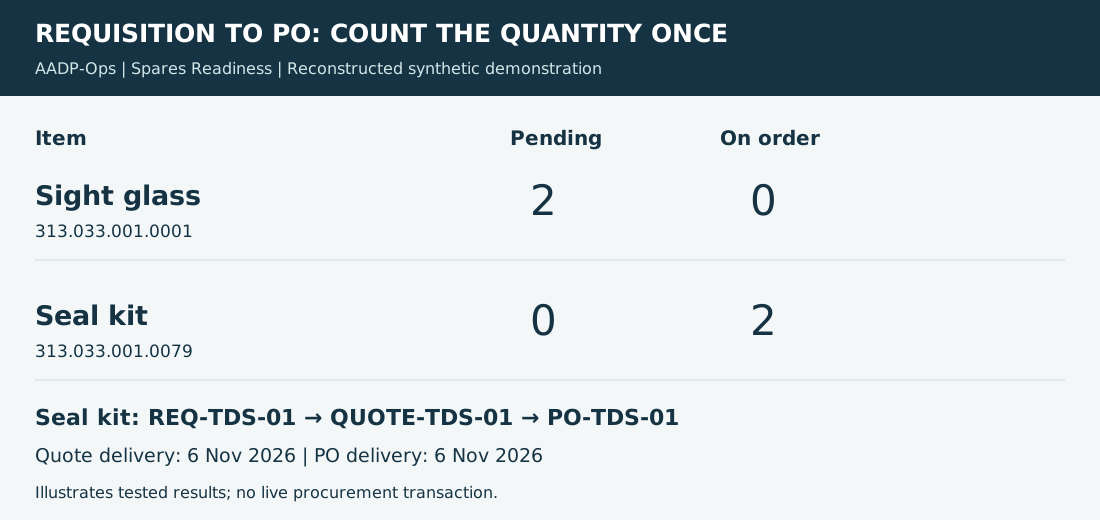
Stores retains control. Departments request through Stores; procurement handles sourcing and approved POs. Physical receipts and issues belong in the authoritative source system and must be restricted to Stores there. This monitoring prototype has no stock-posting or purchasing endpoints.
PM MATERIALS READINESS
Plan against the job date, not just the minimum stock.
The PM view allocates free usable stock and eligible incoming PO balances chronologically across recorded work-order requirements, without allocating the same supply twice. Quarantined stock, pending requisitions, overdue unconfirmed arrivals and deliveries after the job date do not cover demand.
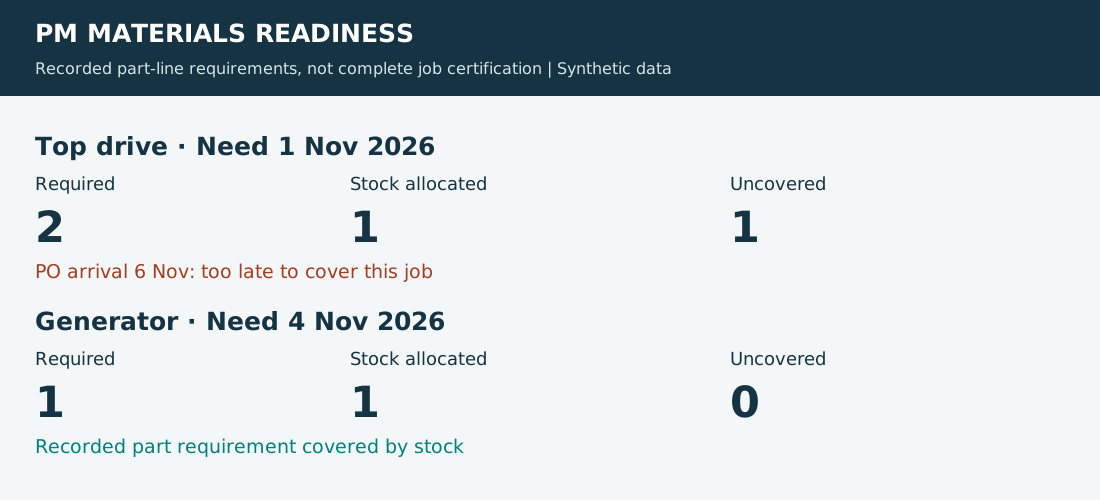
Ordering deadline: requirement date minus supplier lead time, freight, customs, offshore transport and buffer. The example uses an invented total of 50 days. If any required lead-time field is missing, no deadline is invented.
Integration improvement identified: the demonstrated look-ahead is 30 days while sample lead time is 50 days. Effective advance planning needs a horizon covering the longest relevant lead time plus the operator's review margin. The prototype horizon is configurable; this setting must be validated in a pilot.
WHAT WAS TESTED
An alert needs an owner. Acknowledgement is not resolution.
- Detect: the buyer view showed five alerts: two reorder conditions, one material shortage, a PO delivery risk and a cost exception.
- Coordinate: a Drilling department head assigned the delivery alert to the buyer. Separate signed-in identities showed different role views.
- Acknowledge: the buyer's note and timestamp were recorded. The delivery condition remained OPEN.
- Resolve: after the external simulator changed the source conditions, all five buyer-visible alerts became RESOLVED. Assignment and acknowledgement remained visible in that resolved state.
- Recur: returning the source to the risk scenario reopened all five at occurrence two, cleared current acknowledgements and retained the delivery-alert buyer assignment.
Three owner-exported JSON briefs corroborated the risk, resolved and recurrence states. Additional screens demonstrated pending requisitions and their conversion into PO-backed supply. Automated package checks reported 30 passing unit tests for v6.2; these are prototype checks, not production acceptance.
Local alert rows and audit events are not an immutable compliance archive. In-app notifications are demonstrated; email, Teams and push notifications are not configured. The public walkthrough above is illustrative and does not execute these transactions.
WORK ALONGSIDE EXISTING SYSTEMS
Connect the information. Preserve operational authority.
| Source domain | Information to map | Authority retained |
|---|---|---|
| PMS / CMMS | PM dates, work-order demand, component and part applicability | Maintenance scheduling and approvals |
| Inventory / warehouse | Usable stock, reservations, quarantine, min/max and bins | Stores-controlled stock movements |
| Procurement / ERP | Requisitions, quotations, issued POs and outstanding balances | Technical and financial approvals; supplier orders |
| Logistics / shore base | Shipment milestones, customs and expected onboard arrival | Transport and delivery records |
| Controlled documents | Approved drawings, parts lists and revision references | Document ownership and technical verification |
Current connection: a separate simulated SQLite source read through a read-only adapter. AADP-Ops stores its own accounts, cache, notification rules and follow-up state. It does not replace the operational database.
Planned integration: authorised exports, approved APIs or read-only database views, selected with the operator and system vendor. Each system requires validated identity, permissions, schema mapping, timestamps, units and reconciliation. Compatibility with every onboard system is not claimed. No drilling-control, safety-system or equipment-control integration is demonstrated or proposed by this page.
Availability without unnecessary inventory.
The goal is earlier action and better stock decisions, not indiscriminate reductions. Critical insurance spares may be required even with no scheduled PM demand. Engineering and operating requirements must govern those decisions.
Demonstrated
PM part-line allocation, supply timing, requisition/PO visibility, department routing and recorded alert follow-up.
Next to validate
Authorised live-system mapping, complete demand coverage, realistic onboard delivery commitments and user acceptance.
Future development
Risk-based stock recommendations, disruption scenarios and supervised AI-assisted document retrieval. These are not current capabilities.
No measured operating savings yet. A pilot should compare material-related PM delays, critical stockouts, emergency freight, inventory value and follow-up effort against an agreed baseline. No production deployment or customer outcome is claimed.
AADP and the earlier mobile demonstration.
AADP, the Agentic AI Discipline Protocol, is the published framework behind this exploration of disciplined AI-assisted work. AADP-Ops applies explicit scope, evidence and human authority to practical workflows.
The earlier mobile materials trainer demonstrated QR inputs, work-order issue, separate approval, receipt into quarantine and inspected put-away. It is a separate synthetic transactional trainer, not a live connector or the read-only monitoring module shown here.
Read the earlier mobile case studySTART WITH ONE REAL WORKFLOW
Discuss materials readiness with Vijayaprakash.
Begin with one component group, an agreed PM planning window and an authorised source export. Define the data quality, decision owners and acceptance measures before considering integration or rollout.
The working application runs locally for demonstration. No public login or live rig database is available on this page. No demonstration video has been published yet.